Your count says one thing. Your system says another. Don’t fix the number yet: a mismatch means the record and the shelf disagree — nothing more. Find out which side is wrong first. Work the steps in order; some differences will be entry errors, some will stay unexplained, and both are legitimate outcomes.
Don’t adjust the number yet
The instinct at the shelf is to make the system match what you just counted and move on. Resist it: an adjustment changes the record; it does not find the cause. “Fix” the quantity after a bad receiving entry and the same habit produces the next mismatch; shelve a return unrecorded and no adjustment fixes the return bin.
Investigate first, while the evidence is intact — entries, slips, and notes are easiest to read before anyone edits over them. And while you investigate, leave this item’s quantity in the system alone: each later edit overwrites part of the trail you’re trying to read.
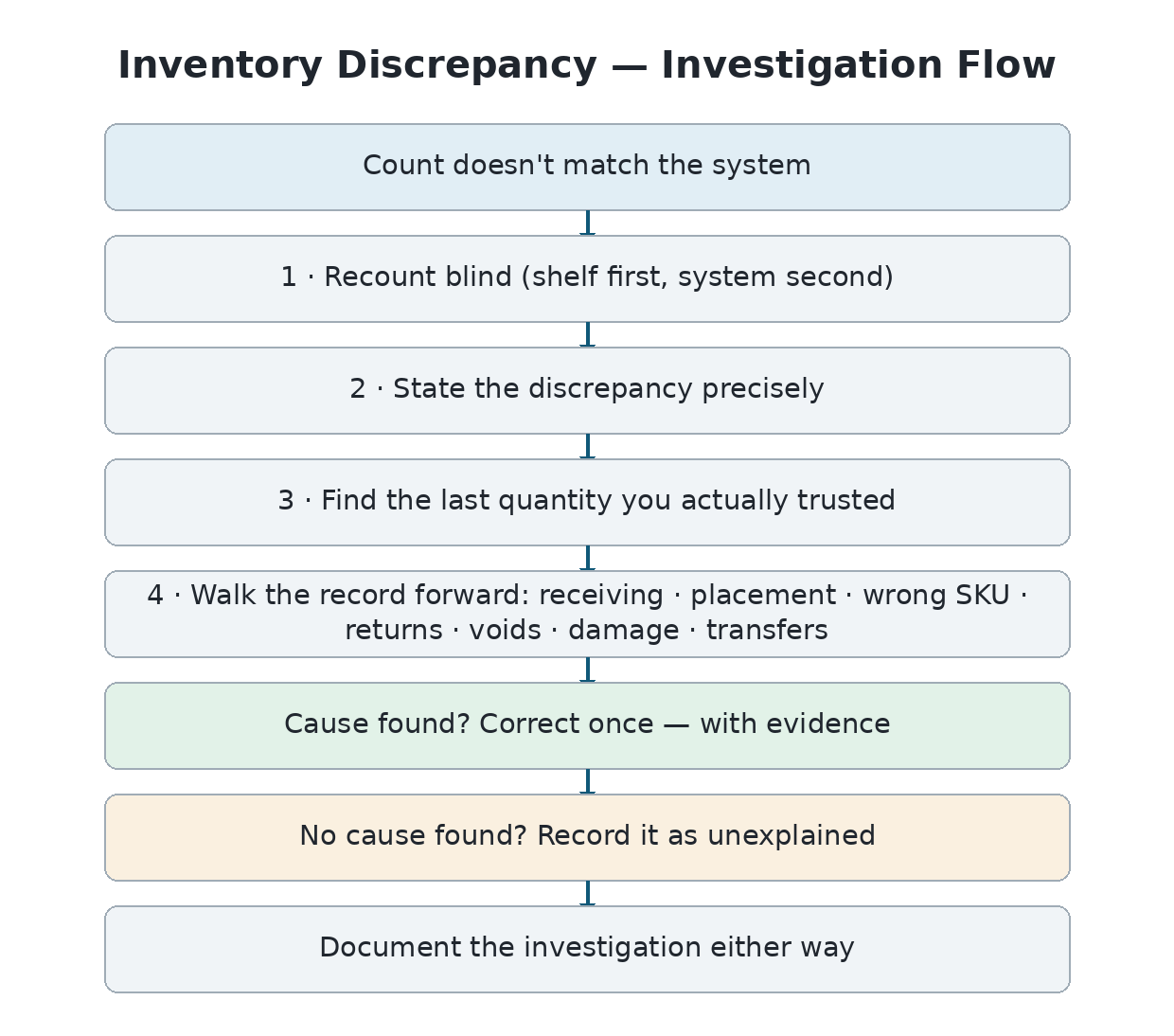
Step 1: Recount blind, then decide
First, confirm the discrepancy is real — with a recount that can’t echo the system.
Count the physical units on the shelf and in storage, and write the number down before looking at the quantity the system expects. In cycle-counting practice this is called a blind count: a counter who can see the expected figure may simply record it instead of counting — consciously or not — to avoid explaining a variance (IndustryWeek, Crowe Horwath CPAs).
This is a shelf-first procedure, not a software feature — don’t expect the system to hide its number. Then apply the gate:
- The recount now matches the system. The first count was a counting or recording error. Note it briefly if useful, and stop.
- The recount still differs. Continue — and if someone else is available, have a second person recount blind first. Two counts that agree independently are the number worth investigating.
Step 2: State the discrepancy precisely
Write down, for one item at a time: item and SKU/variant; location; system quantity; verified recount; date; who counted.
Step 3: Find the last quantity you actually trusted
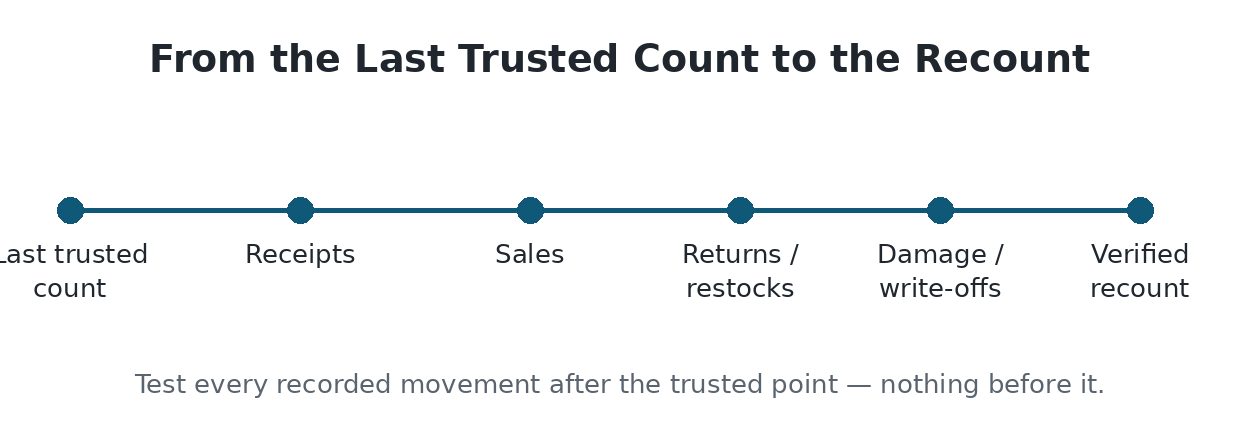
Establish your anchor: the most recent point where this item’s quantity was verified and you trust it — the last physical count you believe, or a delivery you personally checked in. Everything after that point gets tested; nothing before it needs re-litigating.
Working forward from a trusted number adapts audit and cycle-count practice: auditors test the transactions recorded after a trusted physical count (the logic in PCAOB’s auditing standard on inventories). That standard is not a rule imposed on store owners, and nothing here is a compliance duty — the reasoning is borrowed because it works at any scale.
Step 4: Walk the record forward
Test the discrepancy against these branches, in this order:
Receiving or entry error. Compare the delivery evidence — packing slip, invoice, or purchase order — against the quantity actually received and entered, for the right SKU/variant. Was 30 delivered but 40 entered, or a delivery entered twice? The proof is the document that came with the goods; the checks that catch these at the door are covered in our receiving procedures guide. Here you’re using those same documents after the fact.
Misplaced stock. Before treating anything as missing, look where stock hides: back room, overstock, secondary display, returns area. Retail-loss research lists “misplacement in the back room” among the standard causes of mismatched counts. Found units mean nothing was lost — the shelf check was incomplete.
Sold under the wrong SKU or variant. A check, never a conclusion: is a look-alike item (another size, color, or package) drifting the opposite direction — system higher than shelf while yours runs lower? A mirrored difference is a lead in the sales record, not proof.
Returns and restocks. Two opposite failure modes: a return recorded but the unit never reached the shelf, or the unit shelved but the restock never recorded. Decide restock-or-not at the moment of return, and make sure that decision is what’s recorded. (In Shopify, processing a return offers an explicit “Restock at” choice for the item’s location.)
Voids, refunds, and adjustments. Did a recorded movement never happen — or happen twice? A void that left the unit in stock on paper, a refund entered without the return, an adjustment typed the wrong way. Where your system keeps a history of quantity changes (Step 6), read it here.
Damage or write-offs found but never recorded. Check the damage bin and the expired/broken shelf. Stock pulled as unsellable but never written off stays in the system quantity — so the shelf comes up short until the write-off is recorded.
Transfers, pack sizes, counting. Transfers matter only if the item moves between locations (recorded one way, moved the other?). If you buy in cases but sell singles (or the reverse), verify how that delivery was entered — a hypothesis to check, nothing stronger.
Counting error was settled in Step 1 — and note what’s not an early branch: theft, which comes last, only through Step 5.
Step 5: When the difference stays unexplained
Some findings will reconcile; the rest may not. The remainder has a proper name: an unexplained discrepancy, or unknown shrink. The ECR Retail Loss Group defines unknown shrinkage by exactly this: loss discovered when records are checked against the shelf, whose “nature and causes are not identifiable.”
Hold this fence firmly: a discrepancy does not equal theft, and it does not identify any person, shift, or act. The investigation produces documented facts and, where facts point to one, a tighter process — nothing more. No accusations, confrontations, or searches of belongings: this evidence cannot support them.
Two related boundaries. If a system’s adjustment history names who made an adjustment, that identifies the account behind the recorded change — not who caused an underlying loss. The entry records a correction; by itself, it is not evidence about how any units went missing. And shortage costs come out of the business, not out of pay by default: deducting for shortages can violate federal wage law where it pulls pay below the minimum wage (U.S. Department of Labor, retail fact sheet), and state rules differ — check yours. This article isn’t employment advice.
Step 6: What the system should show you
Investigations run on records, so ask three things of whatever system you use: a per-item history of quantity changes? Who and when on each change? A stored reason or note?
Capabilities differ, and the differences matter. In Shopify, the Help Center documents an adjustment history for tracked products — who made each change, when, and how it affected quantities — and a manual adjustment can carry a picked reason (Correction, Count, Received, Return restock, Damaged, Theft or loss, Promotion or donation). The product view shows the last 180 days; a changes report can be filtered by staff member and by reason. Where your system keeps that kind of trail, it’s your investigation’s backbone.
If your system keeps no history, the investigation still works on documents — packing slips, invoices, return slips, register reports — just slower, with some questions unanswerable.
Step 7: Correct once, with evidence
After the walk, corrections fall into three kinds:
(A) An identifiable transaction or entry error (a delivery entered as 40 that the packing slip shows as 30): correct that entry to match its document.
(B) A documented loss or write-off (damaged or expired stock you physically found and pulled): record the change with the reason and the item itself as evidence.
(C) An unresolved remainder (whatever stays unexplained): record it as an unexplained discrepancy, with your verified count as the evidence for the new quantity.
Where your system lets you attach a reason to an adjustment, use it — and name the proof in a note (“packing slip, delivery of Oct 2”). Reason codes exist in counting programs for a practical reason: patterns become visible only as recorded causes accumulate. A log full of unexplained entries tells you nothing next quarter; one with reasons shows whether your problem keeps being receiving, damage, or returns.
Keep three things from blurring. A platform capability is what your software happens to do. A recommended control is a practice, like reasons and notes, that eases the next investigation. A legal requirement is neither — and this article invents none: the IRS (Publication 583) supports keeping records that support your books, including year-end inventory value; it does not require reason codes, approvals, or any adjustment workflow. Valuation and tax questions belong to your accountant.
Document the investigation
For each discrepancy, a compact record is enough: item and SKU; date discovered; system quantity; verified recount; records checked; explanation found (or “unexplained”); correction made; the evidence; who recorded it.
This is a practical recommendation, not a regulatory requirement. In a one-person store, have the owner or a second person review the adjustment log later — the compensating check when one person does it all.
Worked example
Everything below is a hypothetical example; every number is illustrative — none is a benchmark, norm, or threshold.
One SKU. Your last trusted count: 180 units, system agreed. Since then the record shows receipts +100, sales −150, one return restock +2, recorded damage −2: an expected (and actual system) quantity of 130.
Step 1. Blind count: 121. Second person’s blind recount: 121 — confirmed, 9 fewer units than the record says.
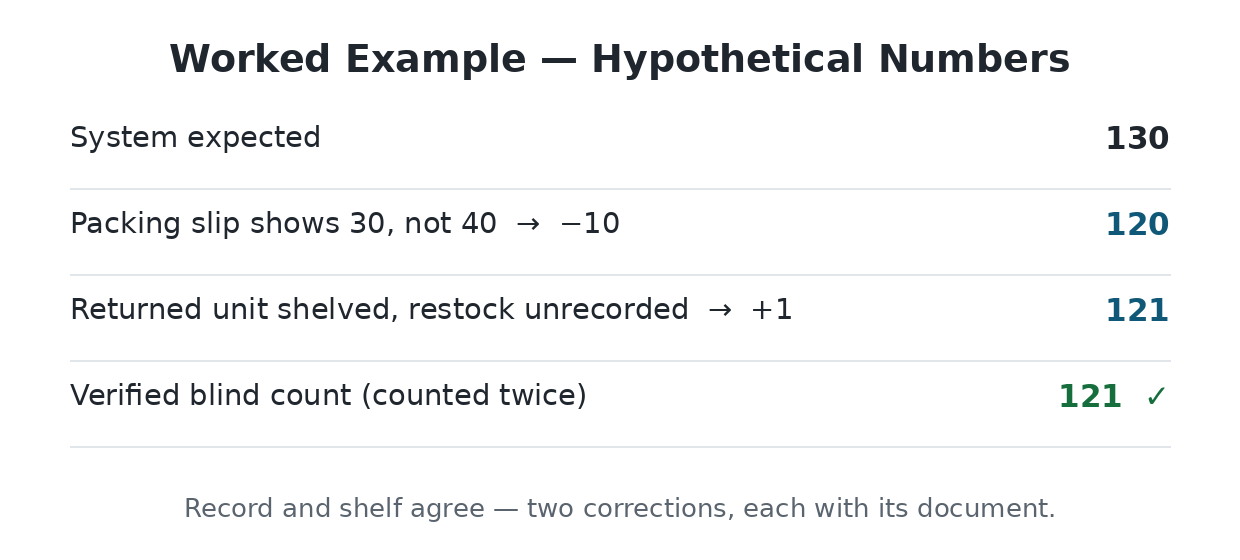
Steps 3–4. Walking forward from 180: delivery #2 was entered as +40, but its packing slip shows 30 — overstated by 10, so the corrected expectation is 120. The shelf is now one over that: a returned unit sits in the returns area, put back yesterday without its restock recorded. Record the restock (+1): record 121, shelf 121.
Step 7. Two corrections closed the case: receiving −10 (proof: packing slip) and unrecorded restock +1 (proof: return slip). Real life is untidier than this example — a remainder may stay unexplained. Record it as unexplained, without reading anything into its size: these 9 units mean nothing outside this example, and neither would 2 or 40 in yours.
Prevention added: every delivery’s packing slip kept on file, and returns shelved the same day with their slip — removing both causes found here.
When to strengthen controls
If the same SKU — or the same branch, like receiving or returns — keeps producing discrepancies: count that item more often and tighten the step where causes keep appearing. A stronger counting routine may eventually be justified; it’s a separate project this article doesn’t teach.
FAQ
Should I just adjust inventory to match the shelf?
Not first. Adjusting buries entry errors, unrecorded restocks, and unrecorded damage under a correct-looking number. Investigate first; adjust last, with a reason and the evidence named.
What if the recount is still different?
The discrepancy is confirmed and worth walking: anchor at the last quantity you trusted and review the movements since, branch by branch.
How far back should I investigate?
To the last quantity you actually trusted — a verified count or a checked delivery — and no further than your documents reach.
Does a discrepancy mean an employee stole?
No. It means the record and the shelf disagree. The branches to rule out first are paperwork and process: entries, restocks, write-offs, placement. What remains is unexplained: unknown shrink is by definition loss whose causes aren’t identifiable, not evidence against any person.
What if my system has no adjustment history?
Run the investigation on documents — packing slips, invoices, return slips, register reports — and keep your own discrepancy record (see “Document the investigation”).
When should I involve an accountant or a manager?
An accountant, for valuation or taxes — this article stops at the shelf and the record. A manager or owner, as second reviewer of the adjustment log, and whenever corrections repeat in the same place. Actual evidence of theft belongs with legal advice, outside this procedure.
Sources
- Wentzel, D. & Hochberg, G. (Crowe Horwath LLP), “Reaping the Benefits of Cycle Counting,” IndustryWeek.
- ECR Retail Loss Group, Inventory Accuracy working group.
- PCAOB, AS 2510, Auditing Inventories (adapted framework only).
- Shopify Help Center, “Viewing inventory adjustment history”; returns processing.
- IRS Publication 583, Starting a Business and Keeping Records.
- U.S. Department of Labor, Wage and Hour Division, Fact Sheet #6 (Retail Industry under the FLSA).