Your cash drawer gets balanced at the end of every shift. The register is counted, the deposit is logged, and most nights the numbers agree. That nightly routine is the backbone of your cash controls — but it raises a question most owners never ask out loud: who checks the checker?
A cash drawer audit is the answer. It is an occasional, independent, unannounced count of a drawer, compared against what your records say should be in it. It is not a second nightly reconciliation, and it is definitely not a fraud investigation. Think of it as maintenance for your cash-control system: the same way you service a register or back up your point of sale, you periodically verify that the process you rely on every night is actually being followed.
This article is the companion to our end-of-day reconciliation guide. That guide owns the scheduled nightly process — the full counting and arithmetic method. This guide owns the verification layer: the occasional independent spot check that confirms the routine is real. A surprise count only works if there is a documented normal process to compare against, so if you have not set up nightly reconciliation yet, start with Cash Drawer Reconciliation: A 10-Minute End-of-Day System for Small Businesses first, then return here to build the audit layer on top.
What a Cash Drawer Audit Is (and Isn’t)
A cash drawer audit is a spot check. At an unannounced moment, someone other than the person who normally closes that drawer counts the cash in it and compares the total with the expected cash position — the amount your records say should be there, given the opening float, cash sales, refunds, payouts, and drops recorded so far.
The key word is verification. A reconciliation checks the math at the end of the day. An audit checks the process: are floats being set correctly? Are payouts and refunds documented as they happen? Are drops being recorded? The audit does not re-teach anyone how to count cash — it verifies that the system you already built is working the way you think it is.
Just as important is what an audit is not. It is not an accusation. It is not a test of any one employee’s honesty, and it is never evidence of misconduct on its own. If you catch yourself thinking of a surprise count as a trap, stop — that framing will poison both the process and the team culture around it. A well-run audit is invisible to customers and unremarkable to staff: a routine check of the system, performed the same way every time, with results documented and filed.
Why the “Surprise” Part Matters
Fully predictable verification is not verification of the normal routine. If everyone knows the count happens every other Tuesday at 2 p.m., then what you are really checking is how the drawer looks when everyone knows it is about to be checked — a rehearsed version, not the everyday one. For the audit to tell you anything true about your ordinary process, the exact timing cannot be completely predictable.
That has nothing to do with suspicion. Think of a fire drill, a health inspector’s visit, or a mystery shopper: the point is to observe the normal state of things. Framing the program that way — to yourself and to your team — keeps it honest and sustainable.
A few practical rules keep the surprise element fair:
- Vary the day, the time, and the register. Avoid any pattern a calendar could reveal.
- Do not announce the count in advance to the person working the drawer. Brief your managers on the program’s purpose once, up front, so nobody interprets a mid-shift count as an accusation.
- Do not disrupt the business. Pick a lull, pause new sales at that register for the few minutes the count takes, and get the drawer back in service quickly.
- Keep the tone boring. An audit should feel like inventory or a temperature log — a routine operational task, not an event.
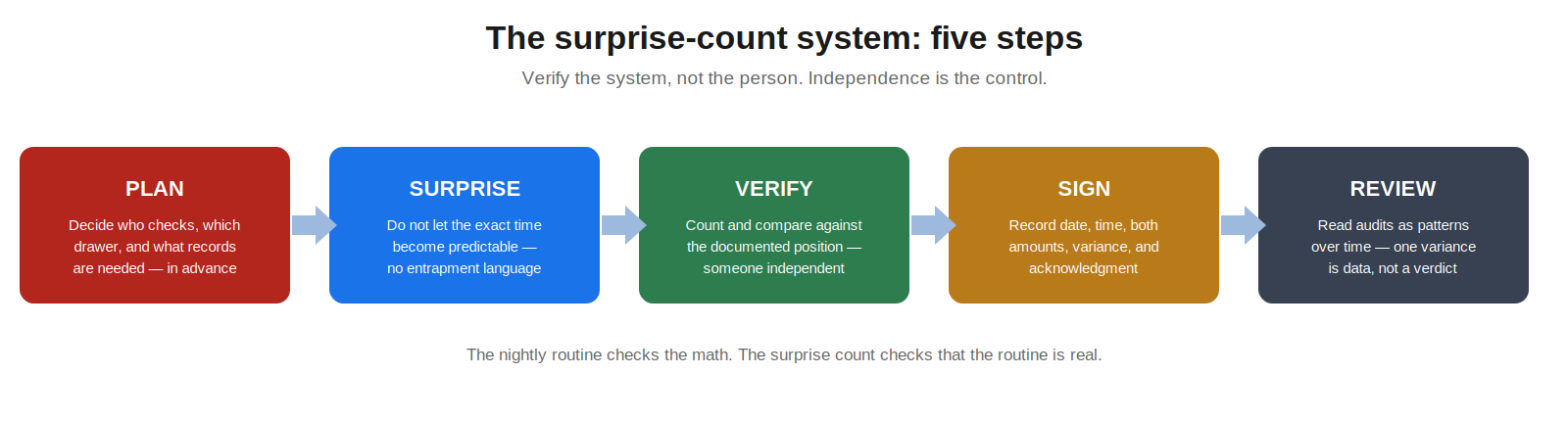
The Five-Step Framework: Plan, Surprise, Verify, Sign, Review
An audit program needs a procedure, not just good intentions. This five-step sequence makes each count operational — repeatable, teachable, and documented.
1. Plan
Every audit starts before the count. Decide who is allowed to perform checks (the owner, or a manager who does not normally close that drawer — more on independence below), which drawers and locations are in scope, and what records must exist for a count to be meaningful. Confirm the baseline: every drawer starts from a recorded opening float, the register or POS records cash sales, and refund slips, payout receipts, and drop logs are kept as a matter of routine. If any of those records are missing, fix the routine first — you cannot verify a process that is not documented.
Plan what happens after a variance, too, before you ever find one. Decide where completed audit sheets will be filed and how long you will keep them, and adopt the findings ladder later in this article so that a short drawer triggers a procedure, not a mood.
2. Surprise
Choose a moment that is genuinely unannounced: a different day than last time, a different register, a different point in the shift. The person performing the count arrives without warning, selects the drawer, and begins. The one rule that matters most here: never let the timing become so routine that staff can set their watches by it. A count everyone saw coming verifies nothing about your everyday process.
3. Verify
The checker counts the physical cash in the drawer — bills, coins, and anything else your records treat as cash — then compares it with the expected cash position from the records: opening float, plus cash sales, minus cash refunds, minus documented payouts, minus cash drops. The full method for building that expected number is documented in the reconciliation guide; the audit’s job is to use the records your process already produces, not to redo the nightly math from scratch.
Two details keep the verification credible. First, pause activity at the register while the count is happening so nothing moves in or out mid-count. Second, the person counting should be someone other than the person who normally reconciles that drawer. Independence is what turns a recount into an audit.
4. Sign
Write everything down while the count is fresh: the date, time, location, and register; everyone involved; the expected and counted amounts; the variance; an explanation if one is known; whether follow-up is required; and signatures or acknowledgment where appropriate. The sheet below includes every field. A completed, signed sheet is the whole point of the exercise — without it, the count never happened as far as your records are concerned.
5. Review
One audit is a data point; ten audits are a story. File the sheets and review them on a schedule — monthly is plenty for most small operations. Look for patterns rather than treating any single variance as a verdict: does the same drawer drift short every Friday? Do variances cluster around shift changes or payouts? A single variance is a question. A pattern is an answer about your process.
Who Should Do the Count
Independence is what separates an audit from a recount. When the same person who closes a drawer also verifies it, a mistake in the nightly routine can sail through the “check” unchallenged — the checker shares the closer’s blind spots. Having the count done by someone other than the person who normally reconciles that drawer is the single most effective upgrade you can make to this program. Public-sector cash-handling guidance has long treated this as standard practice: the North Carolina State Treasurer’s internal-controls guidance, for example, calls for periodic surprise cash counts conducted “by staff members other than those responsible for the cash.”
In practice, that means:
- The owner or a shift manager counts a drawer they do not normally close.
- With multiple registers, rotate: whoever closes Register 1 audits Register 2, and vice versa.
- No one audits their own drawer. If someone ran the register all day, they do not perform the surprise count on it.
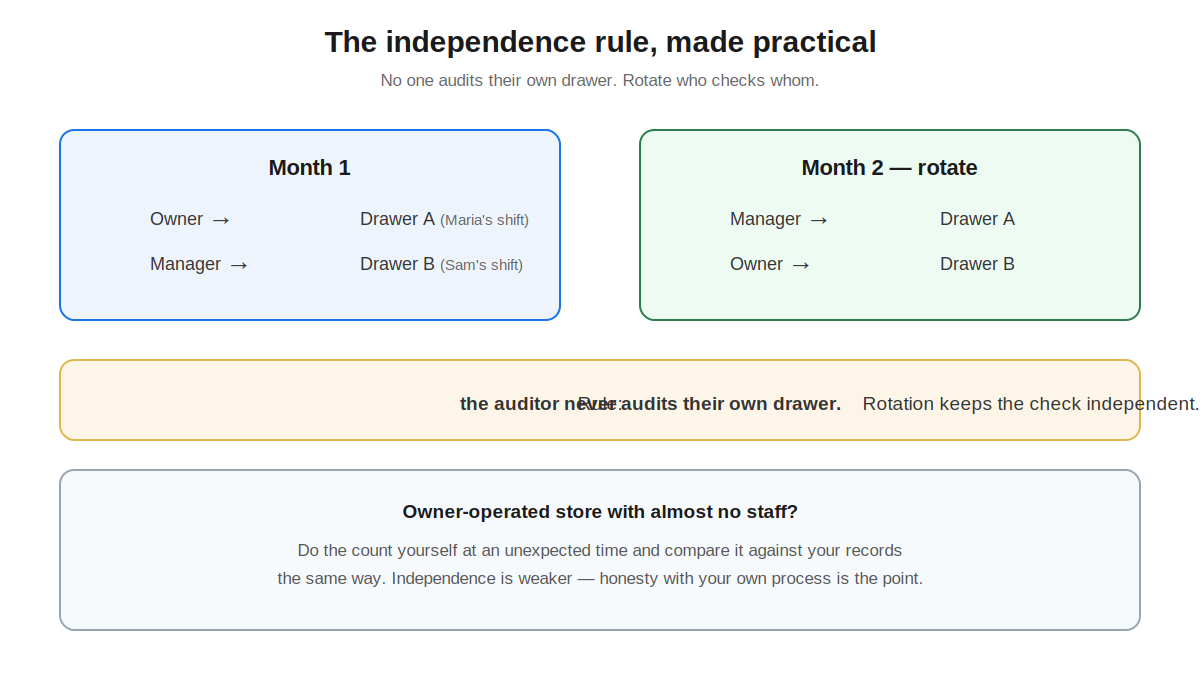
This is a principle, not a mandate — it applies when staffing makes it practical. Plenty of small stores cannot field a second person, and the program should not demand what the roster cannot supply. If you run an owner-operated shop with one or two people, the realistic alternative is straightforward: you, the owner, do the count yourself at an unexpected time and compare it against the records the same way. You lose the second pair of eyes, but you keep the two features that matter most — the count is unannounced, and it is compared against the documented position rather than done from memory. The Washington State Auditor’s Office makes the same point for tiny public agencies: a small staff does not make oversight impossible; it means the oversight has to be designed around the staff you actually have.
One more boundary: the person performing the count should never be put in the position of investigating a coworker. The checker’s job is to count, document, and file. Interpreting results is the owner’s job, during review — not at the register.
What You Need Before You Count
An audit is only as good as the records it is checked against. Before the count, the checker gathers:
- The recorded opening float for the drawer
- The POS or register report of cash sales for the current shift or day
- Refund slips and records
- Payout receipts
- The cash drop log
- A blank audit sheet and a pen
If those records are not there, the count cannot verify anything — the audit becomes a number without a baseline. That is still useful information: it tells you the documentation routine needs attention, which is a Level 1 finding on the ladder below.
How the Verification Works, Step by Step
- Choose the moment. An unannounced time during a lull in customer traffic.
- Pause the register. No new transactions at that drawer until the count is done.
- Pull the records. Opening float, cash sales so far, refunds, payouts, drops — everything listed above.
- Count the physical cash. Bills and coins, methodically, one denomination at a time.
- Compare. Counted cash minus expected cash equals the variance. Over or short — write down whichever it is.
- Record and sign. Complete the sheet on the spot.
- Return the drawer to service. A practiced count takes about ten minutes.
Note what is missing from this list: a full tutorial on computing the expected cash position. That method belongs to the nightly reconciliation process, and it is documented in the reconciliation guide linked above. The audit assumes the routine exists and uses its records.
The Cash Drawer Audit Sheet
Use one sheet per audit. Print a stack and keep them with your office supplies so a count never waits on paperwork. The sheet below is the complete template — no signup, no download, no email required. Print it straight from this page.
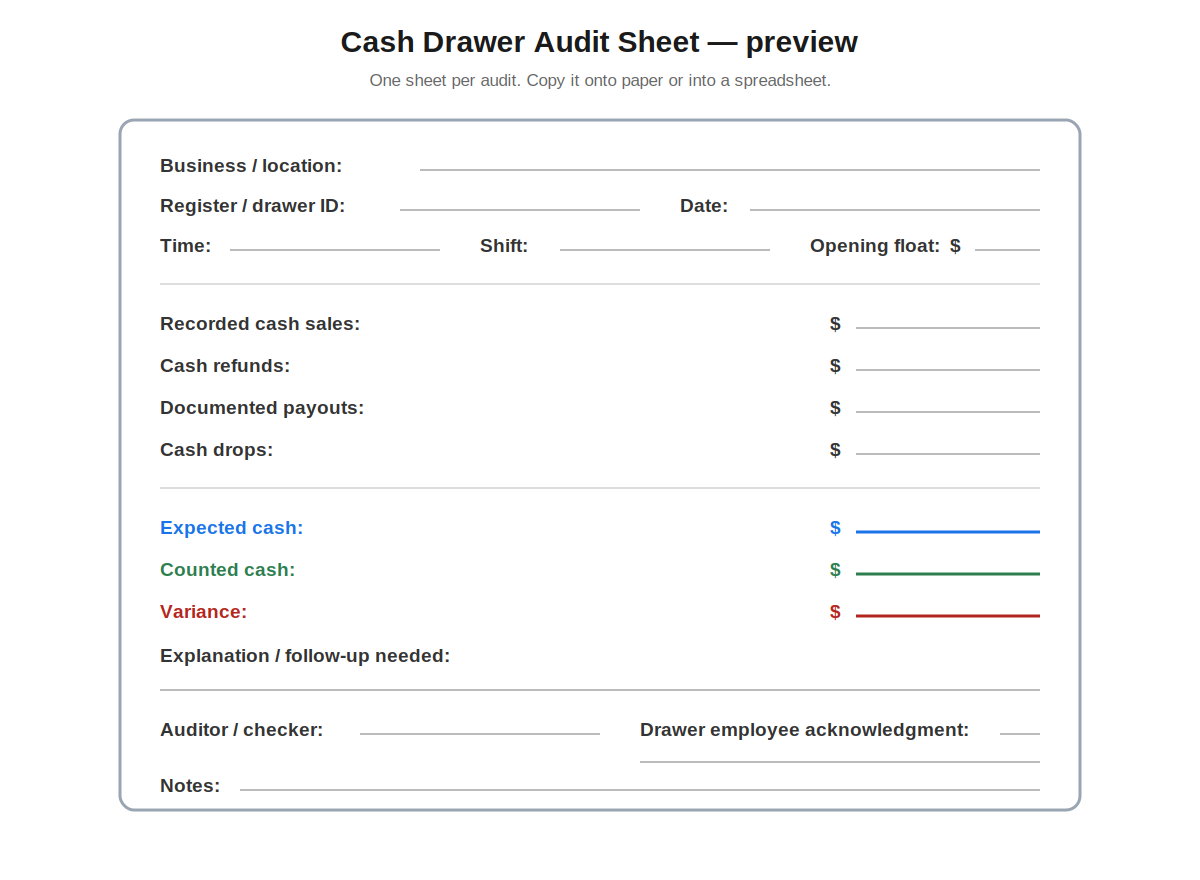
| Field | Entry |
|---|---|
| Business / location | |
| Register / drawer ID | |
| Date | |
| Time of count | |
| Shift | |
| Opening float ($) | |
| Recorded cash sales ($) | |
| Cash refunds ($) | |
| Documented payouts ($) | |
| Cash drops ($) | |
| Expected cash ($) | |
| Counted cash ($) | |
| Variance ($) | |
| Explanation (if known) | |
| Follow-up needed? (yes / no) | |
| Auditor / checker (name and signature) | |
| Drawer / shift employee acknowledgment (where appropriate) | |
| Notes |
A Worked Hypothetical Example
Hypothetical example. The numbers below are invented to show how an audit works — not to teach reconciliation math. Watch what the owner does after finding a small variance.
Maple Street Books is a fictional two-register bookstore. On a Thursday afternoon, the owner decides to audit Register 2 — a drawer she does not normally close. The records for the day so far show:
- Opening float: $150.00
- Cash sales (POS report): $486.00
- One cash refund: $12.00
- One documented payout (cleaning supplies): $20.00
- One cash drop to the safe: $200.00
Expected cash = 150 + 486 − 12 − 20 − 200 = $404.00. She counts the drawer: $399.00 in bills and coins. Variance: −$5.00.
What happens next is the whole point of the system:
- Document. She fills in the sheet: expected $404.00, counted $399.00, variance −$5.00, explanation “not yet known,” follow-up “yes — verify records.”
- Verify records and process. Back in the office, she re-checks the day’s slips. The payout receipt for the cleaning supplies reads $25, but it was keyed into the log as $20. The $5 difference matches the variance exactly.
- Note the result. On the sheet she writes: “Variance explained — payout keyed as $20, receipt shows $25. Documentation error, not a cash loss.” She initials the correction.
- Review patterns later. At month’s end she notices two more keying errors on payouts at Register 2 — a pattern pointing at the payout-logging step, not at any person. She adds a five-second “read the receipt total back” habit to the payout routine.
Notice what did not happen: nobody was accused, nobody was watched, and the $5 was never treated as proof of anything except a process worth tightening.
The Findings Ladder
Every variance gets the same first response: document it. What happens next depends on the pattern, not the amount. Work up this ladder — never skip to the top.
Level 1 — Small, isolated, unexplained variance
Document it on the sheet, do a basic records re-check, and note the outcome. Most audits end here. A few dollars that cannot be explained after a reasonable check is a prompt to watch the process, not a verdict on anyone.
Level 2 — Repeated procedural mistakes
The same kind of error keeps appearing: payouts keyed wrong, refunds logged late, the float miscounted at opening. The response is process work — examine training, shift handoffs, how payouts and refunds are documented, change-making habits, and recordkeeping. Fix the step, not the person.
Level 3 — Recurring unexplained pattern
Variances keep appearing without an identifiable procedural cause. Increase process review and independent verification: audit more often for a while, tighten documentation requirements, have a second person verify payouts and drops. You are still working on the system.
Level 4 — Potential misconduct concern
If, after genuine process review, a pattern still suggests something beyond procedural error, stop here. This guide provides no investigation tactics, and you should not improvise any. Follow your company’s written policies and obtain appropriate HR, legal, or accounting guidance before doing anything else. Do not confront, accuse, or punish any employee based on drawer variance alone.
How Often Should You Run Spot Checks?
There is no universal schedule, and anyone selling you one is guessing. Frequency is a management-policy decision — yours — influenced by:
- Cash volume. More cash moving through the drawer means more exposure to error.
- Number of drawers and registers. Each one is a separate process to verify.
- Number of shifts. More handoffs mean more chances for documentation gaps.
- History of documentation errors. A drawer with a clean record needs less checking than one with recurring slips.
- Operational complexity. Multiple locations, event sales, and seasonal rushes all raise the stakes.
- Recent unexplained variances. A pattern under review justifies more frequent verification until it resolves.
A high-cash-volume convenience store running three shifts is a different situation from a boutique that takes mostly cards. Set a cadence you can actually sustain — an ambitious schedule you abandon after a month is worse than a modest one you keep for a year. And review the cadence itself during your periodic review: if variances are rising, verify more often for a while; if the process has been clean for months, you can ease off. The schedule is part of the system, and the system gets reviewed.
The Owner Review Workflow
Put a recurring appointment on your calendar — monthly works for most small businesses. Pull the filed sheets and ask five questions:
- What is the variance trend — improving, flat, or worsening?
- Does the same drawer, register, or shift keep appearing?
- Is it the same type of issue each time (payouts, refunds, float, drops)?
- Which follow-ups from last month are still open?
- Did any process change we made actually fix anything?
Write a one-paragraph note with your answers and any process change you decide on, and keep it with the sheets. This is the habit that turns a stack of counts into an actual control system.
What This System Does Not Cover
Draw a bright line around the audit program. This guide does not cover employee interrogation, covert surveillance, bag searches, detention, disciplinary procedures, termination decisions, wage or paycheck deductions, accusations of theft, criminal investigation, or law-enforcement strategy. A cash shortage never automatically permits a payroll deduction or discipline — those are legal and HR matters governed by your policies and applicable law, and they sit entirely outside this guide. If a situation moves beyond process review, get qualified guidance. The audit system’s job ends where those questions begin.
Frequently Asked Questions
What is a cash drawer audit?
It is an occasional, independent, unannounced count of a cash drawer, compared against the expected cash position shown by your records. Its purpose is to verify that your cash-handling process is being followed — not to re-do the nightly reconciliation and not to investigate anyone.
Is a cash drawer audit different from balancing a cash drawer?
Yes. Balancing (reconciliation) is the scheduled end-of-day routine that checks the math: counted cash versus expected cash. An audit is an occasional spot check, done by someone independent at an unannounced time, that checks whether the routine itself is being followed correctly. One checks the numbers; the other checks the system that produces the numbers.
Who should perform the count?
Someone other than the person who normally closes or reconciles that drawer — typically the owner or a manager — when staffing makes that practical. In very small owner-operated stores, the owner can perform the count themselves at an unexpected time, comparing against the records the same way.
Should cash drawer audits be announced?
No — the exact timing should not be completely predictable, or the count only verifies a rehearsed version of your process. Brief managers on the program’s purpose up front, vary the day, time, and register, and keep the tone routine rather than dramatic.
What should be recorded during a surprise count?
The date, time, location, and register; the person performing the count; the opening float, recorded cash sales, cash refunds, documented payouts, and cash drops used to compute the expected position; the expected amount, the counted amount, and the variance; an explanation if one is known; whether follow-up is needed; and signatures or acknowledgment where appropriate. The audit sheet above includes every field.
What should I do if the drawer comes up short?
Document the variance on the audit sheet, then verify the records and the process: re-check the day’s slips, receipts, and logs for keying errors before drawing any conclusion. Note the result on the sheet, and watch for patterns across future audits. A variance is a signal for process review — never treat it as proof of misconduct, and never base accusations or discipline on a drawer variance alone.
How often should a small business do spot checks?
There is no universal schedule. Set the frequency as a management-policy decision based on your cash volume, number of drawers and shifts, history of documentation errors, operational complexity, and any recent unexplained variances. Choose a cadence you can sustain, and revisit it during your periodic review.
Sources
- North Carolina Department of State Treasurer, “Internal Control in Cash Receipts” (Exhibit J): periodic surprise cash counts should be conducted for change and petty cash funds by staff members other than those responsible for the cash. (nctreasurer.gov)
- Office of the Washington State Auditor, “Think you’re too small to segregate duties? Let’s find out!” (June 2021): oversight and compensating controls for operations with very small staffs. (sao.wa.gov)
1 thought on “Cash Drawer Audits: A Surprise-Count System for Small Business Owners”
Comments are closed.