At the end of every business day, one question matters more than any other about your cash: does the money in the drawer match what should be there?
Cash drawer reconciliation — also called cash register reconciliation, or simply balancing a cash drawer — is the short end-of-day routine that answers that question. You determine what the drawer should hold according to your records, count what it actually holds, and document any difference. When the two numbers agree, the day closes cleanly. When they don’t, you have a variance to investigate and explain.
This guide is a complete, vendor-neutral system for how to reconcile a cash drawer in about ten minutes at the end of the day — whether you run a modern point-of-sale (POS) system, an older electronic register, or a paper receipt book. It gives you the six-step workflow, the two formulas that do all the math, a worked example using ordinary shop numbers, a diagnostic sequence for the nights the numbers don’t match, guidance on reading patterns across days and shifts, and a one-page reconciliation sheet you can print and use tonight. No accounting background required, and nothing here ties you to any POS vendor.
One note before we start: this guide distinguishes standard control principles (widely used practices for protecting cash), practical recommendations (what tends to work well in small shops), hypothetical examples (clearly labeled, with made-up numbers), and business-specific policy (decisions each business makes for itself). Those are different things, and the guide keeps them separate.
What cash drawer reconciliation actually is
Cash drawer reconciliation is the daily comparison of two numbers:
- Expected cash — what your records say should be in the drawer at close.
- Counted cash — what is physically in the drawer when you count it.
The difference between them is the variance (sometimes called the cash variance). If counted cash is less than expected, the drawer is short. If counted cash is more than expected, the drawer is over. If they match, the drawer is balanced.
Reconciliation is a control, not an accusation. Its job is to catch mistakes early — a refund slip that never got filed, a cash drop recorded for the wrong amount, change counted back wrong during a rush — while the trail is still fresh. Done daily, it protects the business from slow, unnoticed losses, and it protects your staff, too: a clean daily record settles questions before they become suspicions.
It is not a full audit, it does not replace your bookkeeping, and a single variance is not evidence of wrongdoing — it is a signal that something deserves a second look, nothing more, until records and patterns say otherwise.
Know your numbers: the vocabulary and the two formulas
Every reconciliation uses the same handful of terms. Agree on these with anyone who closes a register, because half of all reconciliation confusion comes from people using the same words for different things.
- Opening float (sometimes called the bank): the starting cash placed in the drawer at the beginning of the shift or day so the cashier can make change. It is not sales revenue — it is the business’s own money — and it should be the same amount every day.
- Cash sales: cash taken in from customers during the shift, as shown by your POS or register records.
- Cash refunds: cash paid back out to customers for returns or voided sales, as recorded.
- Documented payouts (sometimes called “paid outs”): cash taken from the drawer to pay a business expense — a supply run, a delivery, a repair — supported by a receipt or a written payout slip.
- Cash drops (sometimes called safe drops): cash removed from the drawer during the shift and secured elsewhere — a safe, a locked bag, a bank deposit — to keep the drawer from holding too much cash. Each drop should be documented with the amount, time, and who moved it.
- Expected cash: the amount your records say should be in the drawer at close.
- Counted cash: the amount physically in the drawer when you count it at close.
- Variance: counted cash minus expected cash.
The entire arithmetic of end of day cash reconciliation is two formulas:
Expected drawer = Opening float + Cash sales − Cash refunds − Documented payouts − Documented cash drops
Variance = Counted cash − Expected cash
A negative variance means the drawer is short; a positive variance means it is over; zero means balanced.
One caution: POS configurations differ. Different systems treat transactions differently — some record drops and payouts in dedicated fields, some net them against sales, some handle refunds as negative sales — and labels vary (“paid outs,” “safe drops,” “drawer pulls”). Follow your own system’s transaction treatment when you pull the expected figure, and make sure everyone who closes a drawer knows where each number lives in your setup. The principle is universal; the button labels are not.
The six-step system: PULL → COUNT → COMPARE → EXPLAIN → SIGN → FILE
The whole routine is six steps, always in this order:
- PULL — get the expected figure first. Pull the expected cash total from your POS or register report before you touch the cash. This sequencing is the heart of the system: the expected number must come from the records, independently of whatever you are about to count. Count first, and you will keep “recounting” until the count matches what you hope to see — and the check becomes theater.
- COUNT — count the physical cash. Count everything in the drawer the same way every time — bills first, largest to smallest, then coins, is a common convention. Keep the opening float identifiable: count the full drawer and confirm the known float within it, or set the float aside first and count the rest. Pick one method and use it daily.
- COMPARE — counted minus expected. Subtract the expected figure from the counted figure. The result is your variance: short, over, or balanced.
- EXPLAIN — investigate and write it down. If there is a variance, work the diagnostic sequence below and write one line explaining what you found — or that no cause was found. Even a zero variance gets a one-line confirmation. A written-down unexplained variance is a data point; one that lives only in memory is nothing.
- SIGN — name, date, time. The closer signs with name, date, and time. This standard control principle fixes responsibility for the close and makes the weekly review possible.
- FILE — keep the record. File the sheet where the owner or manager can review it — a binder, a folder, a scanned archive. The daily sheet is half the system; the other half is the owner reading a week’s sheets together and spotting patterns.
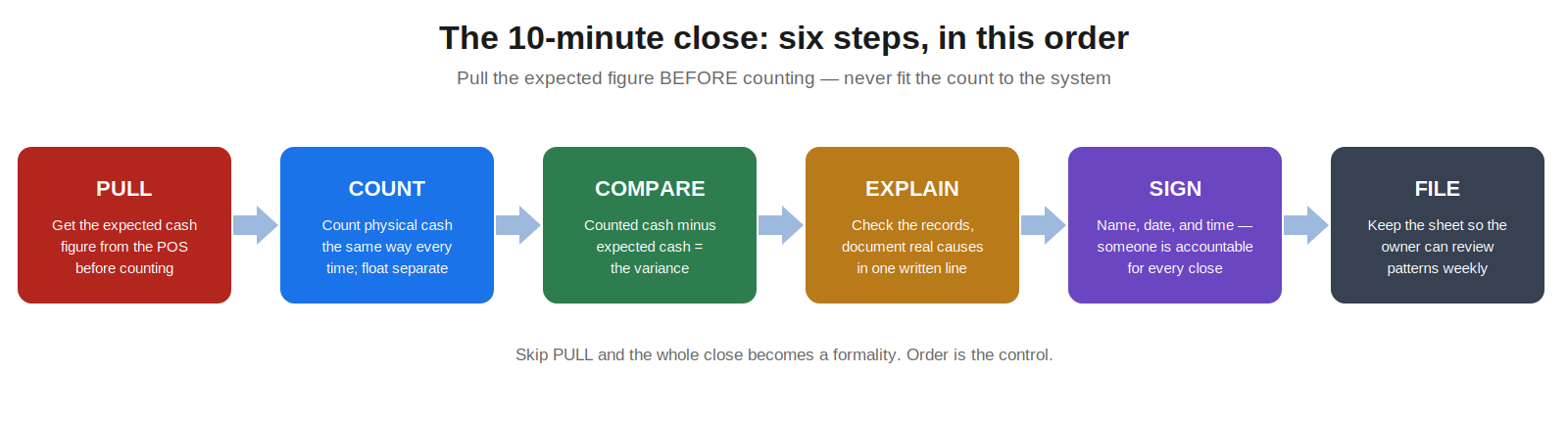
The 10-minute end-of-day SOP
Here is the routine as a standard operating procedure. Tape it inside a cabinet door or keep it in the close-out binder so anyone trained on the register can close correctly. A practiced closer finishes in about ten minutes.
- Close the shift/register. No more sales go through this drawer. If your system has an end-of-shift or close-register function, run it now.
- Pull expected cash. Display or print the register/POS report for the shift and note the expected cash figure. Write it on the reconciliation sheet before counting.
- Gather the documentation. Collect the day’s refund slips, payout receipts, and cash-drop slips. Stack them with the sheet — every number on the sheet should have paper behind it.
- Count the physical cash. Count the full drawer contents in your standard order. Write the counted total on the sheet.
- Identify the opening float. Confirm the float amount (it should match the standard float you started with) and keep it visible in the math.
- Calculate expected cash. Opening float + cash sales − cash refunds − documented payouts − documented cash drops.
- Calculate the variance. Counted cash − expected cash. Note whether the drawer is short, over, or balanced.
- Check the obvious. If there is a variance, recount once and verify the slips before assuming anything else. Most variances are resolved at this step.
- Record the explanation. One written line: what the variance was and what caused it, or that no cause was found.
- Sign and file. Name, date, time — then file the sheet for the owner review.
The SOP does not ask the closer to interrogate anyone, adjust the books, or “fix” the numbers. The closer’s job is an honest count, an honest comparison, and an honest line of explanation. Judgment about patterns belongs to the owner review.
Worked example: the arithmetic, step by step
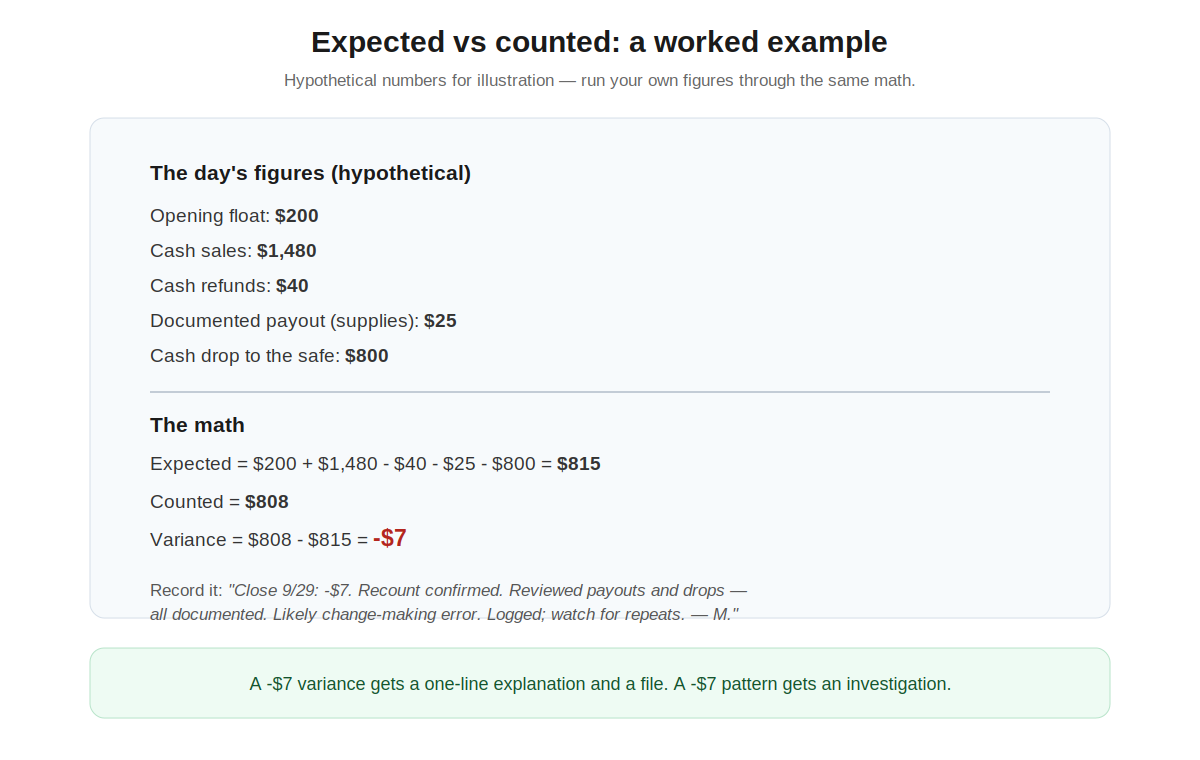
Everything in this section is hypothetical — made-up numbers for an imaginary shop, shown so you can see exactly how the math works. Run your own numbers through the same steps tonight.
The hypothetical close:
- Opening float: $200.00 (hypothetical)
- Cash sales for the day: $1,480.00 (hypothetical)
- Cash refunds: $40.00 (hypothetical)
- Documented payout: $25.00 (hypothetical — a supply run, with receipt)
- Cash drop to the safe: $800.00 (hypothetical — mid-afternoon, slip on file)
Step 1 — expected cash. Apply the formula:
Expected = $200.00 + $1,480.00 − $40.00 − $25.00 − $800.00
Work it left to right: $200.00 + $1,480.00 = $1,680.00. Subtract refunds: $1,680.00 − $40.00 = $1,640.00. Subtract the payout: $1,640.00 − $25.00 = $1,615.00. Subtract the drop: $1,615.00 − $800.00 = $815.00 expected.
Step 2 — counted cash. The closer counts the drawer and finds $808.00 (hypothetical).
Step 3 — variance. Counted − expected = $808.00 − $815.00 = −$7.00. The drawer is $7 short.
Step 4 — explain. The closer recounts, checks the slips, and finds nothing obviously wrong — the refund slip, payout receipt, and drop slip all check out. The written line for the sheet reads (hypothetical): “Drawer $7.00 short. Recounted; all slips verified; no cause identified. Flagged for owner review.” The closer signs, dates, times, and files it.
That is the whole job. The $7 is a documented data point, not a drama. If next week’s sheets show another small unexplained shortage, the owner has the start of a pattern; if not, it was most likely an ordinary slip, and the system worked as designed.
Short or over? Diagnose in this order
When expected and counted cash disagree, work this sequence before drawing conclusions about people — most common and most innocent causes first. Most variances are resolved in the first few steps. Do not jump from a variance to an accusation of theft: that shortcut destroys trust, and it is usually wrong.
- Recounting error. Count again — in a different order, or have a second person count. Simple miscounts are the most common cause of variance, full stop.
- Wrong denomination count. Check for the classic slips: tens counted as twenties, a stack of ones assumed to be fives, coins mis-added. Recount by denomination and write each subtotal down.
- Missed refund. Was a cash refund given but the slip never filed or never entered in the register? Check the refund paperwork against the system’s refund total.
- Undocumented payout. Did someone take cash from the drawer for a business expense — supplies, a delivery, a repair — without writing a payout slip? Ask, don’t assume; then write the slip now, late but honestly.
- Incorrect cash drop. Was the drop amount recorded wrong, or is the drop slip missing? Verify the drop against what actually went into the safe or bag.
- Change-making error. During a rush, wrong change goes out more often than anyone likes to admit. Large bills tendered for small purchases deserve a second look.
- Wrong payment type entered in POS. A cash sale rung up as a card sale (or the reverse) moves money between the expected-cash figure and the card totals without any cash actually being wrong. Compare the cash and non-cash tender totals against the system’s report.
- Opening-float problem. Was the float correct at the start of the shift? A miscounted float, or a float topped up informally during the day, poisons every number downstream.
- Prior-shift issue. If the previous shift’s close was off and nobody caught it, today’s variance may be yesterday’s error surfacing. This is why every shift gets its own sheet and its own close.
- Transaction-recording error. Voids, discounts, and no-sale drawer openings handled inconsistently in the register can all move the expected figure. Check the system’s transaction log for the shift.
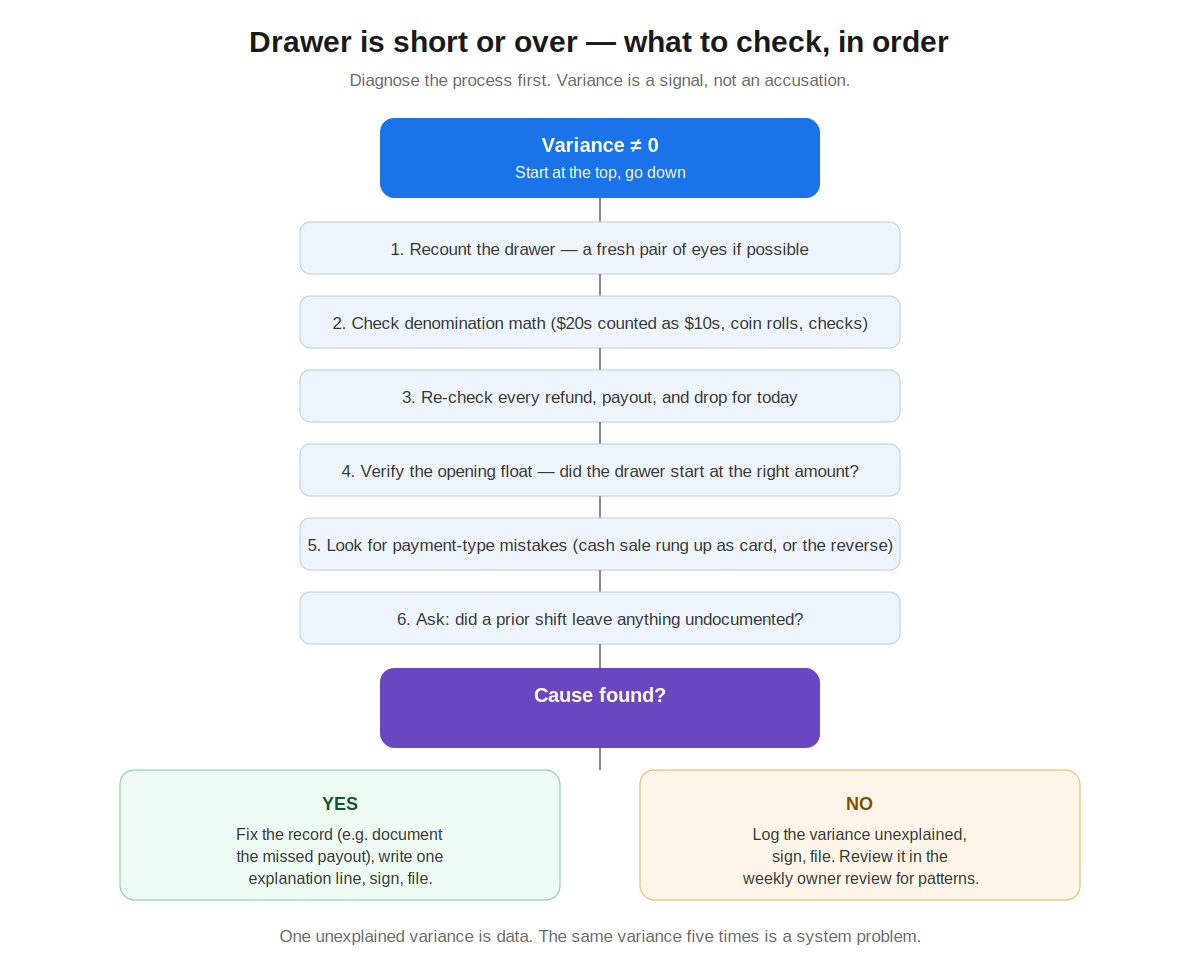
Only after these checks — with records and patterns in hand — should a variance be escalated beyond “unexplained, flagged for owner review.” Escalation means a calm, documented review of the records, not a confrontation: the process gets examined before the people do.
Reading patterns across days and shifts
One variance is a data point; a week’s worth of sheets is information — read it for process signals, not verdicts. Patterns suggest where to look, never what you will find.
- Repeated small shortages may indicate a process problem worth investigating — a register that mis-tenders certain payment types, a rush-hour change-making habit, a float that drifts. A pattern like this does not identify the cause, and it certainly does not identify a culprit.
- Round-number differences — exactly $20.00, exactly $50.00 — may suggest an undocumented payout or drop, or some other operational cash movement that bypassed the paperwork. Round numbers are worth a question about procedure (“are we writing payout slips every time?”), not a conclusion about anyone.
- Repeated variance on one shift or register is a signal for process and record review: retrain on the close procedure, check the register’s configuration, look at staffing patterns during that shift. It is not evidence of misconduct.
- Repeated exact-zero reconciliation — every sheet balancing to the penny, day after day — does not prove anyone fabricated a count. But real drawers handled by real humans during real rushes produce occasional small variances, so an unusually perfect run can justify checking that counts are being done independently and documented consistently — for example, verifying that the expected figure is genuinely pulled before counting.
The rule: never accuse employees based on variance alone. Variance is information about the process — treat it that way, and staff will treat the system as the protection it is, not a trap. That trust keeps the system working.
Control practices that make the system work
The six steps are the routine; these practices are what keep the routine honest. Each is labeled so you know what kind of guidance it is.
- Keep a consistent opening float. Practical recommendation. The same float every day makes the math checkable at a glance and makes float problems visible immediately.
- Document every payout. Standard control principle. No cash leaves the drawer without a written slip: amount, purpose, receipt attached, who authorized it. Undocumented payouts are among the most common sources of variance.
- Document every cash drop. Practical recommendation. Amount, time, and who moved the cash, on a slip that stays with the day’s paperwork.
- One accountable closer per drawer, where operationally feasible. Practical recommendation — not a universal rule. When one trained person owns the close for a drawer, responsibility is clear. Small shops with overlapping shifts can’t always do this, and it is not legally required as a general matter; where you can’t, the written sheet matters even more.
- Keep the expected-vs-counted comparison independent. Standard control principle. The expected figure comes from the system, pulled before counting — never reconstructed from memory to match the count.
- Write the variance explanation every time. Standard control principle. One line, even when the line says no cause was found. The discipline of writing is what builds the pattern record.
- Sign with name, date, and time. Standard control principle. Every close is attributable, which is what makes the weekly review meaningful.
- Run the owner/manager weekly review. Practical recommendation. Ten to fifteen minutes with the week’s sheets — the subject of the next section.
The weekly owner review: 10–15 minutes that run the system
The daily close produces the records; the weekly review produces the value. Once a week, spend ten to fifteen minutes reading the week’s sheets together, looking for systems to fix — not people to blame. This is a process review, not an investigation or disciplinary procedure.
Work through this checklist:
- Repeated shortages. Same drawer, same shift, or same size of shortage recurring? Look for the process cause: retraining, a register configuration issue, a rush-hour workflow problem.
- Repeated overages. Overages deserve the same attention as shortages — they are variance too, and they usually mean change-making or tender-type errors running in the other direction.
- Recurring unexplained variance. “No cause found” two or three times in a week means the diagnostic sequence needs to go deeper or the close procedure needs retraining — not that someone is guilty.
- Registers or shifts with process problems. Does one register always seem to be the one? Check its setup, its location during rushes, and who closes it — as a training and equipment question.
- Missing payout or drop documentation. Slips missing two days running is a procedure failure. Fix it with a pad of payout slips kept in the drawer and a rule: no slip, no payout.
- Inconsistent opening floats. If the float isn’t the standard amount, find out why — and reset the standard.
- Recurring payment-type mistakes. Cash rung as card (or the reverse) showing up repeatedly points to register training or a confusing tender screen, not to dishonesty.
Then fix the system first: retrain, reconfigure, re-supply — and note the fix and date so next week’s review can check whether it worked. That loop (observe the pattern, fix the process, check the result) is the entire payoff of daily reconciliation.
Variance thresholds: a review trigger, not a permission slip
There is no universal “acceptable” cash variance — not in this guide, and not anywhere else you should trust. A dollar means something different in a food truck doing $400 cash days than in a garden center doing $9,000 cash days. Anyone quoting you a standard acceptable shortage is inventing a benchmark.
What a business can do is set its own internal review threshold: a line, appropriate to its volume and controls, above which a variance gets same-day attention from the owner or manager. That is a business-specific policy, and it is yours to set — or not set — as you see fit.
Two things a threshold is not: it is not permission for unexplained loss below the line (every variance still gets its written line and its sheet), and it is not a target. The threshold exists so that large variances can’t wait for the weekly review. Small, documented, explained variances are the system working; silence is the thing a threshold guards against.
Your printable daily reconciliation sheet
Here is the full Daily Cash Drawer Reconciliation Sheet, built as a real table you can use right inside this article — no download, no signup, no email gate. One page per drawer per shift. Print this page (Ctrl+P or Cmd+P) and the table below is your sheet.
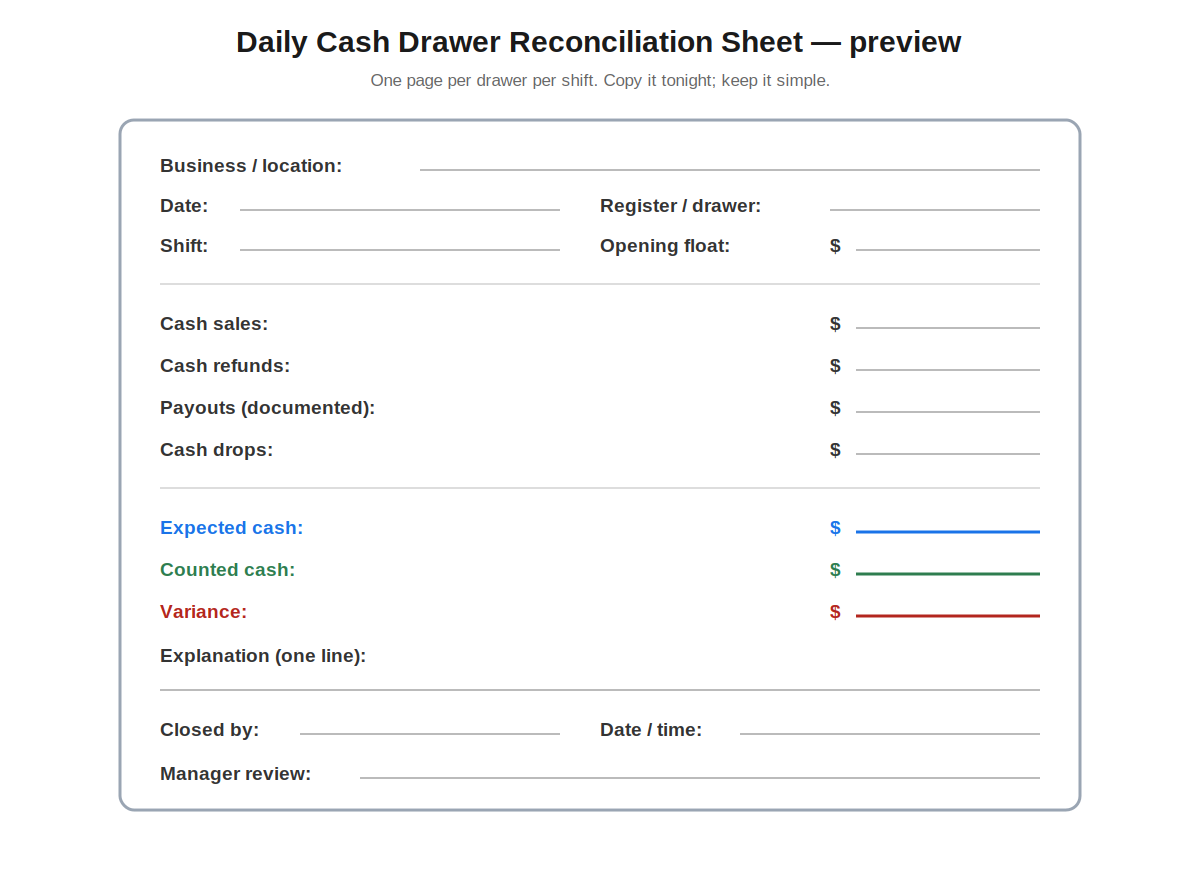
| Field | Entry |
|---|---|
| Business / Location | |
| Date | |
| Register / Drawer | |
| Shift | |
| Opening float | $ |
| Cash sales (per POS / register) | $ |
| Cash refunds | $ |
| Documented payouts | $ |
| Cash drops | $ |
| Expected cash (float + sales − refunds − payouts − drops) | $ |
| Counted cash | $ |
| Variance (counted − expected; + = over, − = short) | $ |
| Explanation (one written line) | |
| Closed by (signature) | |
| Date / Time of close | |
| Manager review (initials / date) |
No POS? The low-tech version
Everything in this guide works without a point-of-sale system. The paper version of cash drawer reconciliation needs four things: a calculator, a notebook or a printed stack of the sheet above, a pen, and an envelope.
- Expected cash comes from your paper record: the day’s receipt copies or register tape, added up by hand. Cash sales are the receipt total; refunds are the refund slips; payouts are the payout slips; drops are the drop slips. The formula doesn’t change — only where the numbers come from.
- Counted cash is the same physical count, done the same way every day.
- Documentation lives in the envelope: every slip for the day goes in, the date gets written on the envelope, and it is filed with the sheet.
- The float matters even more on paper — without a system enforcing it, write the standard float amount at the top of every sheet and verify it at open.
Paper reconciliations take a few minutes longer because the adding is manual, but they catch the same errors — and writing every number by hand makes skipped documentation harder to miss.
Frequently asked questions
What is cash drawer reconciliation?
It is the daily routine of comparing the cash your records say should be in the drawer (expected cash) against the cash actually in the drawer (counted cash), calculating the variance, documenting any difference, and filing the record. The routine is also called balancing a cash drawer or end of day cash reconciliation.
How long does it take to reconcile a cash drawer?
About ten minutes once it is routine: pull the expected figure, count the cash, do the two-formula math, write the explanation line, sign, and file. The first few closes take longer while everyone learns the sequence.
What does it mean if my cash drawer is short or over?
Short means the counted cash is less than expected; over means it is more. Both are called variance, and both get the same treatment: recount, work the diagnostic sequence, write down what you find. A single short or over drawer is normally an ordinary error — a miscount, a missed slip, wrong change — not evidence of anything worse.
What is an acceptable cash variance?
There is no universal acceptable amount. Your business may set its own internal review threshold — a level at which a variance triggers same-day owner attention — appropriate to your sales volume and controls. A threshold is a review trigger, not permission for unexplained loss: every variance still gets documented.
Should the same person who worked the register do the count?
In most small businesses, the person closing does the count — that is normal and workable. What matters more than who counts is that the expected figure is pulled from the system independently before counting, the explanation is written down, and the owner reviews the week’s sheets. Larger operations may separate duties further; that is a business-specific policy decision.
What should I do with a cash overage?
Document it exactly like a shortage: record the amount, work the diagnostic sequence (wrong change and tender-type errors are the usual causes), write the explanation line, and file the sheet. Keep the overage with the business’s cash records — it is not a tip and not a windfall. Repeated overages get the same pattern review as repeated shortages.
Do I need a POS system to reconcile a cash drawer?
No. A POS makes pulling the expected figure faster, but the system works on paper: receipt copies or register tape for sales, slips for refunds, payouts, and drops, and the same two formulas. See the low-tech section above.
1 thought on “Cash Drawer Reconciliation: A 10-Minute End-of-Day System for Small Businesses”
Comments are closed.