Most small businesses get referrals by accident. A happy customer mentions you to a friend, that friend shows up months later, and you never find out how they heard about you — or how to make it happen again. That is not a referral strategy. That is luck with a good business behind it.
The good news: you do not need expensive referral software, a complicated CRM, or a salesperson’s personality to get a steady flow of referrals. You need a system — a small, repeatable routine that runs the same way every week, whether you feel like doing marketing or not.
The short answer: a referral system is a repeatable routine with six steps — TRIGGER → ASK → REWARD → RECORD → FOLLOW UP → REVIEW. You choose the moment to ask, ask the right customers in plain language, decide whether and how to reward, write every referral down, follow up with both sides, and review the numbers once a month. The rest of this guide builds each step for a local small business: when to ask, who to ask, what to say, whether to pay, how to track it on paper, how to train your team, and how to measure it.
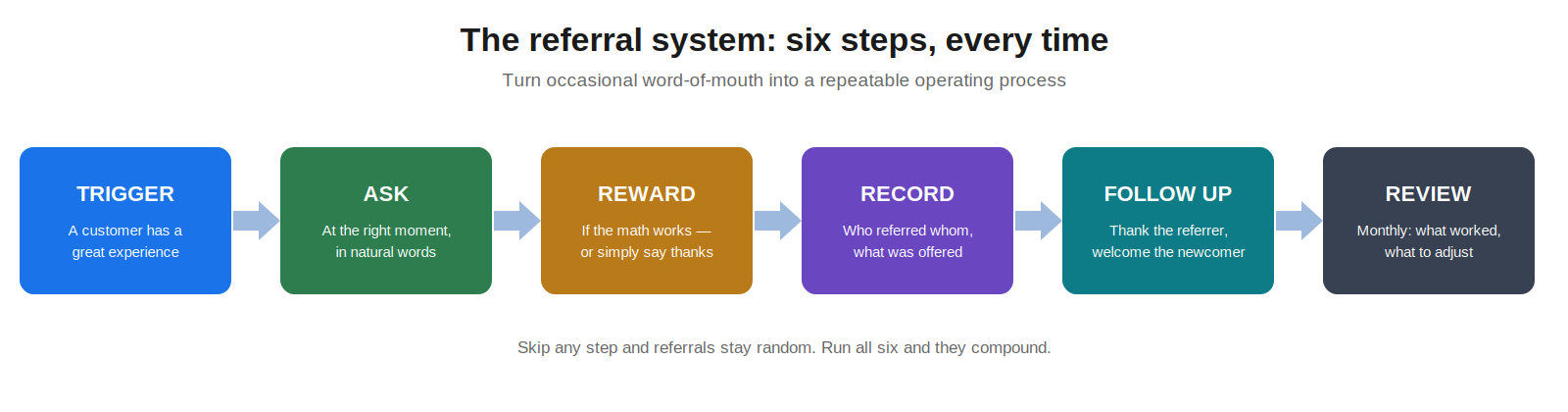
Why “just ask more” is bad advice
“Just ask everyone for referrals” is the most common advice in small-business marketing, and it fails most owners for three reasons.
Timing beats volume. Asking in the checkout line, while a customer is in a hurry, or before they have experienced what you do makes the ask feel transactional — and slightly desperate. The same words, said right after a great moment, feel like a natural continuation of good service. Most businesses do not have an asking problem. They have a timing problem.
Targeting beats volume. Asking every customer equally burns your energy on people who barely know you and risks annoying the merely satisfied. Referrals come overwhelmingly from a smaller group: repeat buyers, enthusiastic fans, and people who already talk about you. A system focuses your asks where they actually convert.
Process beats volume. Owners who “ask more” usually ask randomly, never write anything down, never follow up, and never learn which asks worked. Without a record, nothing improves. Asking is one step out of six — the other five are what turn a habit into a system.
Step 1 — Choose your ask moment
The single biggest lever in your referral system is not what you say. It is when you say it. A referral ask lands when the customer is already thinking something positive about you. Your job is to recognize those moments and build the ask into them — not to bolt a script onto every interaction.
High-probability ask moments:
- Right after a customer expresses satisfaction — “This is exactly what I needed” is an invitation.
- After a service is completed successfully — the final walkthrough, when they see the finished work.
- After a customer leaves a positive review — they just put praise in writing.
- After a repeat purchase — the second or third visit is a strong signal of trust.
- After a problem was resolved exceptionally well — a recovery done right creates fierce loyalty.
- After a customer voluntarily recommends you — they just did it unprompted; make it easy to do it again.
- At natural follow-up points — a check-in call, a thank-you email, a post-appointment message.
Timing differs by business type:
- Service businesses (plumbers, landscapers, cleaners): ask at the final walkthrough, while the customer is looking at the finished work.
- Appointment-based businesses (salons, clinics, consultants): ask at checkout — or better, in a follow-up message a day or two later, once they have lived with the result.
- Retail: ask after a repeat purchase or when a customer praises a product — not at every register beep.
- Restaurants and hospitality: ask regulars, not first-timers. A server’s genuine “we love having you back” is the trigger, not a table tent.
- Recurring and subscription relationships: ask after a milestone — six months in, the first anniversary — or right after you solved a problem for them.
- Higher-ticket local services (roofers, remodelers): ask a week or two after completion in a personal follow-up call. The referral is worth more, so the personal touch is worth it.
The rule: the ask must feel contextual — like the natural next sentence in a good conversation. If it feels scripted into every interaction, the timing is wrong.
Step 2 — Decide who to ask
Ask your best customers, not every customer. You decide who those are from relationship signals you can actually observe:
- Repeat customers — coming back is the strongest vote of confidence there is.
- Customers who gave strong positive feedback — in person, by phone, or in writing.
- Customers who left you a positive review.
- Loyal, high-retention customers — the ones you see month after month, year after year.
- Customers who already referred someone informally — they are your proven channel; make it easier for them.
- Customers whose network naturally contains likely buyers — for example, a real estate agent is a natural referrer for a home-services business. Judge fit by the relationship, not personal details.
What not to do: do not select customers by age, race, gender, neighborhood, appearance, accent, or any other protected characteristic, and do not dig through personal data to decide who is “worth” asking. Your selection rule is the business relationship — how they behave as your customer. If you would be embarrassed explaining your selection rule out loud, it is the wrong rule.
Step 3 — Scripts that sound human
The best referral script is short, specific, and sounds like you on a good day. Steal these, adapt the bracketed parts, and never read them like a teleprompter.
In person:
“I’m really glad we could sort that out for you. Honestly, most of our new customers come from people like you mentioning us to a friend — if anyone you know ever needs [service], I’d love an introduction.”
By SMS or text (after a good visit):
“Hi [Name], thanks for coming in today! If you have a friend who might like [what you do], feel free to send them our way — just have them mention your name. – [Your name]”
By email:
Subject: A small favor?
“Hi [Name],
Thanks for being a customer — it genuinely means a lot.
We grow almost entirely through word of mouth. If there’s someone in your life who could use [service], I’d be grateful for an introduction. Just reply to this email and I’ll take it from there.
Thanks,
[Your name]”
After a positive review:
“Thank you for the review — it honestly helps more than you know. If you ever feel like recommending us directly to a friend, we’d be grateful for that too.”
After a successful service completion (the walkthrough):
“Everything look good? Great. We build this business one happy customer at a time — if you know a neighbor who needs [service], we’d love to help them too.”
When an employee asks on behalf of the business:
“I’m so glad you loved the [cut / meal / service]! [Owner’s name] asked me to mention — if you ever send a friend our way, just have them mention your name and we’ll take great care of them.”
How to ask without being pushy: make the ask once per moment, keep it to one or two sentences, and if they deflect or go quiet, smile and move on. Never ask twice in the same visit, and never make a customer feel the service depends on their answer. The ask is an invitation, not an invoice.
Step 4 — Whether to reward at all
You do not have to pay for referrals. Plenty of local businesses earn steady referrals with great service, well-timed asks, and sincere thank-yous. Rewards can help — but only when the economics work and the program stays simple. Here is an honest comparison of your options.
- No reward, just a thank-you. Cost: nothing. Works when the relationship is strong and the ask feels personal. Downside: no extra nudge beyond goodwill.
- A personal thank-you — a call, a handwritten note, remembering their name next visit. Cheap, memorable, and surprisingly powerful.
- Referrer reward — a discount, credit, or gift for the person who sends the new customer. A direct incentive; watch your margins and set anti-abuse rules (see the fraud section below).
- New-customer reward — the friend gets 10% off or a free add-on. Lowers the barrier for the new buyer; can attract one-time bargain hunters if you are not careful.
- Two-sided reward — both sides get something. The strongest nudge — and the most expensive.
- Store credit — keeps the value inside your business. Excellent for retail, salons, and restaurants.
- Service upgrade — a free add-on at the next visit. Low cash cost, high perceived value; ideal for service businesses.
- Loyalty credit — points toward a future reward. Fits recurring and membership-style businesses.
Weigh the tradeoffs before you pick: margin (can you afford it on every referral?), simplicity (can every employee explain it in one sentence?), fraud and abuse (can it be gamed?), repeat-purchase behavior (does it attract loyal customers or one-time deal seekers?), perceived authenticity (does paying cheapen a genuine recommendation?), and admin effort (will you actually track and pay it every time?).
Rule of thumb: if you are unsure, start with no formal reward and an excellent thank-you. Add a reward only when you can track referrals reliably and the math in Step 5 says yes. Paid referrals are not automatically better than unpaid ones — the best referral program is the one you actually run consistently.
Step 5 — Do the math: what is a referral actually worth?
A reward that costs more than the customer is worth is not marketing — it is a donation. Before offering anything, work out what a referred customer is worth to your business with this simple formula:
Expected value of a referred customer = average first-purchase gross profit + expected repeat gross profit − fulfillment/service costs − referral reward − administrative cost
What each piece means:
- Average first-purchase gross profit: revenue from the first sale minus its direct costs (materials, products, job labor).
- Expected repeat gross profit: what repeat business is typically worth — your average repeat purchases per customer times the gross profit per purchase. Use your own history, and be conservative.
- Fulfillment/service costs: delivery, extra trips, or service costs tied to serving that customer, if not already counted above.
- Referral reward: the full cost of whatever you give — count both sides if the reward is two-sided.
- Administrative cost: your time or staff time to track, verify, and pay the reward. Small, but not zero.
If the expected value is comfortably positive, the reward is affordable. If it is near zero or negative, lower the reward, switch to a cheaper reward type (like a service upgrade), or run on thank-yous until your repeat rate improves.
Worked examples — all numbers below are HYPOTHETICAL EXAMPLES to demonstrate the method, not real benchmarks. Plug in your own figures:
- Low-margin retail (neighborhood hardware store). First purchase $40 at 30% margin → $12 gross profit. A typical customer returns 4 times a year → $48 expected repeat gross profit. Fulfillment costs: negligible. Reward: $5 store credit. Admin: $1. Expected value = 12 + 48 − 0 − 5 − 1 = $54. A $5 credit is easily affordable; a $25 cash reward would not be.
- High-ticket home services (HVAC replacement). First job $8,000 → $2,400 gross profit. Expected maintenance and repeat gross profit: $300. Extra fulfillment costs: $100. Reward: $150. Admin: $25. Expected value = 2,400 + 300 − 100 − 150 − 25 = $2,425. Generous rewards are easily affordable here — stinginess costs more than generosity.
- Salon / barbershop. First cut $60 → about $40 gross profit. A client returns about 8 times a year → $320 expected repeat gross profit. Reward: a free add-on service costing you $8. Admin: $2. Expected value = 40 + 320 − 8 − 2 = $350. Service upgrades beat cash: high perceived value, low cost.
- Professional services (accountant). First engagement → $600 gross profit. Typical annual repeat → $600 expected repeat gross profit. Reward: $100 gift card. Admin: $10. Expected value = 600 + 600 − 100 − 10 = $1,090.
- Restaurant. First visit $70 → about $45 gross profit. A regular returns 6 times → $270 expected repeat gross profit. Reward: a free dessert costing about $6. Admin: $1. Expected value = 45 + 270 − 6 − 1 = $308. Small two-sided perks work well here.
- Recurring service (cleaning company). Monthly plan $160 → $70 monthly gross profit. Typical retention 10 months → $70 first-month gross profit + $630 expected repeat gross profit. Reward: $50 account credit. Admin: $5. Expected value = 70 + 630 − 50 − 5 = $645. With recurring revenue, even modest rewards pay for themselves many times over.
The pattern: the more a customer is worth over time, the more generous you can afford to be. Businesses with thin margins and one-time buyers should lean on thank-yous and low-cost perks; businesses with high lifetime value can fund real rewards.

Step 6 — Track referrals without expensive software
If you do not write it down, you do not have a system — you have a hope. The good news: effective referral tracking needs nothing fancier than consistency. Pick the lowest-tech method you will actually use every time:
- A paper log at the register, in the work van, or by the phone. One line per referral. It works.
- POS notes — add “referred by [name]” to the new customer’s record in whatever point-of-sale system you already use.
- A simple spreadsheet — one row per referral, shared with whoever needs it.
- Referral codes — give your best referrers a simple code (“mention MIKE10”) so the source is captured automatically.
- “How did you hear about us?” — put it on intake forms, booking pages, and first-visit paperwork, and train staff to ask it out loud.
- A simple CRM tag — if you already use a CRM, a “referred” tag on the contact is enough. Do not buy a CRM just for this.
Whatever method you choose, record these fields for every referral: date, referring customer, new customer, source/channel, offer/reward, first purchase value, reward cost, converted? (yes/no), repeat purchase later (if known).
Here is what a simple tracking sheet looks like — sample data is hypothetical, for illustration only:
| Date | Referring customer | New customer | Source / channel | Offer / reward | First purchase value | Reward cost | Converted? | Repeat purchase later? |
|---|---|---|---|---|---|---|---|---|
| 2026-09-04 | Dana W. | Priya S. | In-person ask | $10 store credit | $86 | $10 | Yes | Yes — 2 visits |
| 2026-09-11 | Marcus T. | Leo K. | Text follow-up | Thank-you note | $140 | $1 | Yes | Not yet |
| 2026-09-18 | Dana W. | Ana R. | Referral code DANA10 | $10 store credit | — | $0 | No | — |
Review this sheet in your monthly review (Step 8). After two or three months, it will tell you exactly which triggers, asks, and rewards produce customers — no analytics software required.
Step 7 — Train your team in five minutes
Your system dies if it lives only in your head. Every employee who talks to customers needs the same simple operating rule — five steps, plain language:
- Recognize the trigger. A happy moment from Step 1 — praise, a great result, a repeat visit.
- Make the ask naturally. One or two sentences, in your own words. Never a pitch.
- Explain the reward correctly. The same words every time, so customers hear one consistent program.
- Record the referral. Paper log, POS note, or spreadsheet — right away, not “later.”
- Never pressure the customer. One ask per moment. A “no” or a shrug is a complete answer — smile and move on.
The 30-second employee script — post it where staff can see it:
“When you notice a happy customer: use their name if you know it, say the one-line ask from our script card, and write it in the log the moment they leave. If they say no, thank them warmly and drop it. You are offering an invitation, not closing a sale.”
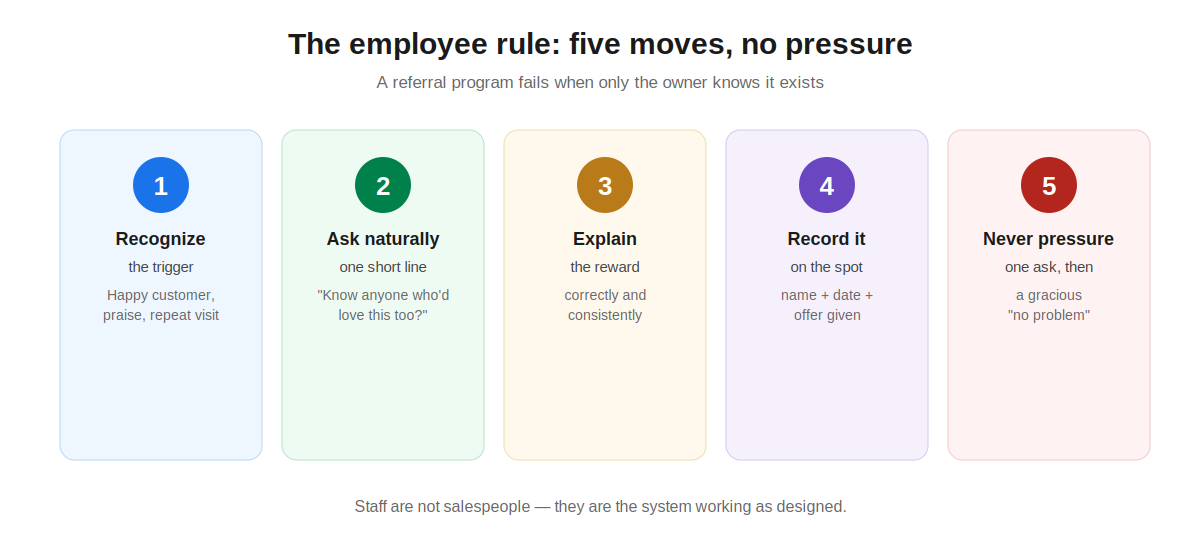
Make asking part of the normal closing routine, not a separate campaign. And recognize employees who do it well — a thank-you in the team chat, first pick of shifts, a small bonus for verified referrals. Your team will only keep asking if asking feels normal and appreciated. They are hosts making introductions, not salespeople working a quota.
Step 8 — Review your results once a month
Thirty minutes, once a month, with your tracking sheet. That is the whole review. Look at these numbers:
- Referral leads generated — names, mentions, and codes received.
- Referral conversion rate — what share of referred leads became paying customers.
- Revenue from referred customers.
- Reward cost — total paid out.
- Gross profit from referred customers.
- Repeat rate of referred customers, where known — referred customers often become your most loyal buyers.
- Cost per acquired referred customer — total reward cost divided by converted referrals. Compare it to what you spend to acquire a customer any other way.
Then change one thing at a time: the trigger, the ask, or the reward. Give each change a full month before judging it. This is the step that turns a nice idea into a system that compounds — most businesses that “tried referrals once” skipped it entirely.
Referrals and reviews are different — do both
Owners often mix these up, so here is the clean distinction:
- Reviews are public proof. One-to-many: a customer tells the whole internet. Reviews build trust at scale and help new customers discover you on Google and Yelp.
- Referrals are private introductions. One-to-one or one-to-few: a customer tells a specific person, with context — “you should call them because…”. Higher trust, higher conversion.
They reinforce each other but they are different mechanisms. A referred prospect will usually check your reviews before buying — so your review presence closes the loop your referral opened. And a happy referred customer becomes your next reviewer and your next referrer. Run both systems; do not confuse them. For the review side of your reputation, see our guides on how to get more Google reviews and Yelp for small business.
Keep it honest: ethics, platforms, and legal lines
A referral program touches trust — your customers’, and the public’s. Keep these lines clear:
- Disclose referral incentives. If someone gets a reward for recommending you, that is an endorsement relationship. The FTC’s Endorsement Guides require clear disclosure of material connections between endorsers and advertisers. For a local program, stating the reward up front — “we give a $10 credit for referrals” — covers most situations. When in doubt, disclose.
- Paying for a referral is NOT the same as paying for a positive review. A referral reward pays for an introduction — the new customer still forms their own opinion and can say whatever they like. A review incentive pays for public praise. Never blur the two, in your program or your language.
- Review incentives are a separate issue with separate rules. Google’s policy prohibits offering incentives — payment, discounts, free goods or services — in exchange for posting reviews, and prohibits selectively soliciting only positive reviews (sometimes called review gating). Keep your referral program and your review requests in separate lanes.
- Regulated professions face extra restrictions. Lawyers, doctors, financial advisers, and real estate agents — among others — may be barred from paying referral fees in some states. Check your licensing board’s rules before offering cash or cash-equivalent rewards.
Preventing fraud and abuse (the practical version)
You do not need enterprise fraud software. You need simple rules that every employee can explain the same way:
- Reward only after a qualifying purchase or payment — never for a name alone.
- Define “new customer” in writing — for example, someone who has not bought from you in the last 12 months.
- One reward per qualifying referral — no double-dipping on the same new customer.
- No self-referrals — the referrer and the new customer cannot be the same person, and watch for households gaming the program.
- Put expiration dates and terms in writing if you run a formal program — one page is enough.
- Keep it simple: complicated programs get gamed; simple ones get followed. If your staff cannot explain the rules in one sentence, simplify the rules.
Your one-page referral system template
Everything in this guide fits on one page. Fill in the blanks, pin it up, and you have a program:
- Our best referral trigger: ___
- Who we ask: ___
- Our exact ask (the script we use): ___
- Reward (amount and type — or none): ___
- How we record it: ___
- When the reward is issued: ___
- Who reviews the results: ___
- Review frequency: ___
Frequently asked questions
How do I ask for referrals without being pushy?
Ask once, at a moment the customer is already happy, in one or two sentences — then drop it completely if they deflect. Pushiness comes from repetition and pressure, not from the ask itself. A single genuine invitation after great service almost never offends.
Do I always need to offer a reward for referrals?
No. Many local businesses earn steady referrals with great service, well-timed asks, and sincere thank-yous. Add a reward when you want to accelerate the system and the math in Step 5 shows you can afford it — not because someone told you paid referrals are automatically better.
How much should a referral reward be?
Work backward from the formula in Step 5: the reward must leave the expected value of a referred customer comfortably positive. There is no universal percentage — a $150 reward can be cheap for a high-ticket service and ruinous for a low-margin shop. Let your own margins decide.
Are referral incentives the same as review incentives?
No, and the distinction matters. A referral incentive rewards an introduction; the new customer forms their own opinion. A review incentive rewards public praise, which platforms like Google prohibit — Google’s policy bars offering payment, discounts, or freebies in exchange for reviews, and bars selectively soliciting only positive reviews. Run the two in separate lanes.
What is the simplest way to track referrals?
A paper log or a one-tab spreadsheet with nine columns: date, referring customer, new customer, source/channel, offer/reward, first purchase value, reward cost, converted (yes/no), and repeat purchase later. Add “How did you hear about us?” to your intake process as backup.
How do I get employees on board with asking?
Give them the five-step rule from Step 7, a one-line script card, and make asking part of the normal closing routine — not a campaign or a quota. Recognize the behavior you want: thank staff who ask consistently and celebrate verified referrals. Never turn it into pressure on them or the customer.
How often should I review my referral results?
Once a month, for about thirty minutes, using your tracking sheet. Look at leads, conversion rate, revenue, reward cost, and cost per acquired referred customer — then change one thing and give it a full month.
How long until a referral system starts working?
You will usually see the first referred customers within a few weeks of asking consistently, because you are harvesting goodwill that already exists. The compounding effect — referrers who refer again, and referred customers who become referrers — builds over months. The monthly review is what keeps it compounding.
Sources
Only sources actually consulted and verified for this article:
- Federal Trade Commission — “Advertisement Endorsements” (the FTC’s endorsements topic page: the Endorsement Guides and disclosure of material connections). ftc.gov — verified live November 4, 2026.
- Google Business Profile Help — “Prohibited & restricted content” (Rating Manipulation section: no incentives offered in exchange for reviews; no selective solicitation of positive reviews). support.google.com — verified live September 29, 2026.
1 thought on “How to Get Referrals for Your Small Business: A Simple System (Not Just “Ask More”)”
Comments are closed.